April 2nd, 2012 by Margaret Skomorokh
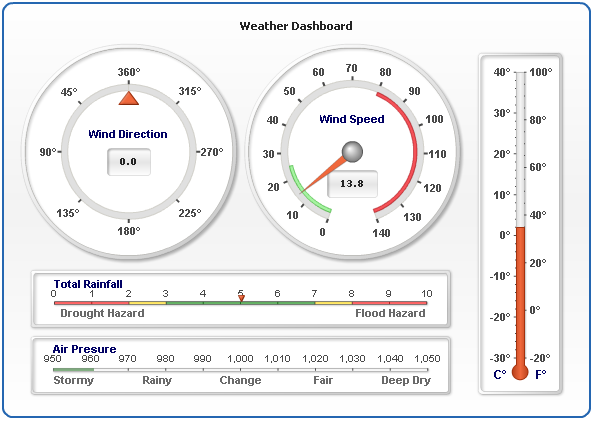
Today we are going to highlight another useful feature of our product. A Gauge (also known as Meter) is an instrument with a graduated scale or a dial for measuring or indicating quantity. As a rule, it is used to show business Key Performance Indicators (KPIs) and to reproduce barometers, thermometers or voltmeters. In AnyChart two types of gauges are available: Circular and Linear.
The Circular Gauge is like gauges on a car dashboard. It consists of a radial scale holding your data range and a pointer. Gauges can be not only circular, but also semi-circular. In fact, AnyChart supports any angle ranges.
Our component also provides the opportunity to implement color ranges, which are used for classifying data. You can set the desired number of different colors depending on the number of your conditions. For example, you may have only 2 colors for satisfactory and unsatisfactory results or a whole palette consisting of 10 colors indicating different temperature ranges.
You can use multiple pointers and even multiple data ranges, place them anywhere or invert data ranges direction. Circular ranges have an adjustable data scale, so you can define its length, minimum and maximum values, and so on.
Horizontal Linear Gauges and Vertical Linear Gauges are sliders or a wide lines (either vertical or horizontal). Their main idea is moving a pointer or pointers over a range of data to some point’s value or the difference between points.
AnyChart gives you the opportunity to use multiple pointers and multiple data ranges, set the width of the line and the number of pointers. Different color ranges for background coloring are available, being a significant and very informative element of your gauge.
With AnyChart you have the freedom to create unique gauges, because all elements are fully adjustable. You can create any gauges needed, make them look like in real life and perform any functions, even surpassing their real analogues.
Here is the list of main available features:
To learn more about Gauges, see our documentation and the following sections of our gallery:
For easy start we recommend you these tutorials:
Gauges can be a very suggestive and useful tool when all their potential is used, and in this post we have tried to give you some clues how to do it.
Also please feel free to ask our support team any questions about working with gauges. Thank you for being with us today.
March 25th, 2012 by Margaret Skomorokh
 One of the most exciting features of AnyChart Stock are Event Markers – a special type of chart markers that are designed to provide the best experience in showing various events on financial charts: Key Developments, Dividends, Splits, Insider Transactions, Analyst Opinion Changes and so on. This information is very important for financial analysis and have to be properly visualized. That is why our component has a very flexible and convenient set of tools for working with Event Markers.
Event Markers in AnyStock can be added to a chart series or to a timeline. Due to the stacking and merging systems, you can put as many markers as necessary and at the same time keep your chart clean and readable. Rich interactivity improves the perception of events by users, and the opportunity to bind Event Markers to additional data turns them into a highly informative tool.
Available options include:
- complete control over all visual settings
- rich interactivity and the opportunity for users to select Event Markers
- grouping markers that hit the same date into stacks or into a single marker
- binding additional data (e.g URL links) to each Event Marker
- built-in elegant tooltip with the support of HTML formatting
- full range of supported external events and methods for controlling Event Markers from the outside
- four special marker shapes
and many, many more…
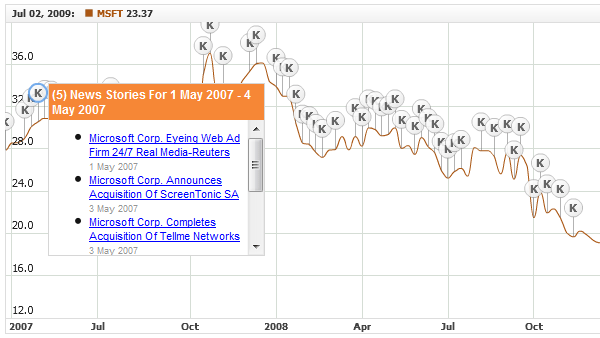
You can learn how to work with Event Markers from our documentation, gallery, and online demos, each of them containing a sample chart, its source code and description. Here is the full list of these demos:
We want you to pay special attention to the following three samples because they can be used in real applications as ready-made building blocks. These samples also demonstrate a number of important characteristics of Event Markers. For example, as it is clear from the two RSS examples, Event Markers can be loaded and removed during runtime, which means that they can be equally as dynamic as data thought not being a part of it.
We hope that we succeeded to throw some light on this useful feature and this article will help you to implement new functionality in your applications, but if anything is still not clear, do not hesitate to contact our support team. We will do our best to help you.
March 13th, 2012 by Margaret Skomorokh
We continue publishing tips for choosing between different types of charts. Last time we were talking about comparing data, and today we will focus on seeing data over time.
The most popular and adequate ways to visualize time-based data are bar graphs and line graphs. What is the difference between them? First, large sets of data are better visualized via line graphs since line graphs are good in showing trends, and bar graphs in this case just look overcomplicated. Second, bar graphs emphasize the magnitude of changes, so they are an excellent way to demonstrate data with sharp fluctuations.
Example 1.
The following graph shows the number of deaths per year in Cambodia between 1960 and 1990 according to UN estimates:
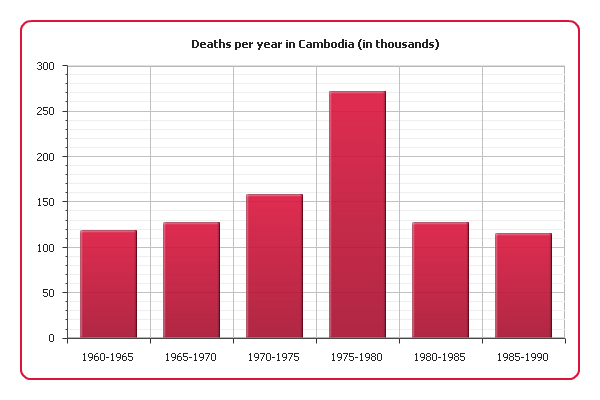
As you can see, there was a sharp increase of mortality in 1975-1980, which is almost the same period when Cambodia was under the Pol Pot regime (1975-1979). Our graph clearly shows the scale of the genocide this regime is responsible for.
Example 2.
And now we are going to demonstrate demographic data about Cambodia for a longer period: since 1950 and including modernity. A bar graph is not the best choice in this situation. Instead, we will use a line graph:
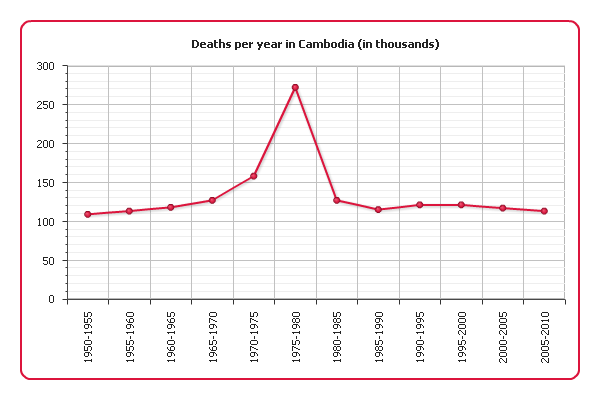
This visualization still shows the increase of mortality in 1975 quite well and at the same time comprehensively represents the long-term trend.
Example 3.
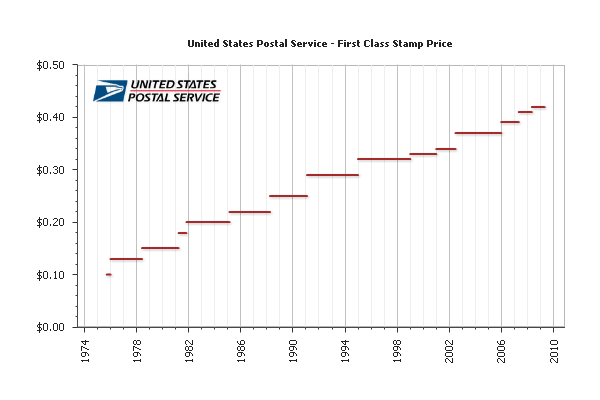
Sometimes a value we are interested in changes discreetly, i.e. stays constant between change points. For example, stamp prices change only in the rare moments when new stamps with new denominations are emitted. In this case we can choose a bar graph since it represents data discreetly, but what if our data covers a long period of time? A bar graph would be difficult to read, but a line graph should not be used either because to connect two points with a line would mean to distort the real picture.
Fortunately, there is one useful variation of line graphs – step line graphs. To connect data points they use only vertical and horizontal segments instead of straight lines. Here is such a graph demonstrating the US Postal Service prices for first class stamps from 1975 to 2008:

Step line graphs combine advantages of bar and line charts, being good at both showing trends and making the magnitude of changes explicit. And by omitting change points you can focus on the periods when the represented value is constant:
See also: Creating Step Line Chart with AnyChart and Line, Spline, Step Line Charts Gallery
That is all for today, more tips are coming soon.
Check the updated article on how to choose chart/graph type for seeing data over time published within the framework of the new 7-part Choose Chart Type feature on our blog.
February 28th, 2012 by Margaret Skomorokh
AnyChart 6.0.8 is available for download. We keep improving our HTML5 engine and fixing the bugs discovered there. We would also like to draw your attention to Vertical and Horizontal Gauges, this instrument being absolutely necessary if you want to show Key Performance Indicators and Bullet Graphs in Scorecards and Dashboards. As for basic chart types, we have added a couple of useful features, without which it is sometimes very difficult to go.
HTML5 engine now supports:
- Vertical and Horizontal Gauges
- the TreeMap plot
- Aqua styles for 2D Pie and 2D Doughnut chart types
- 3D Pie and 3D Doughnut chart types
New labels features:
Version history: http://6.anychart.com/products/anychart7/history/
Trial download: https://www.anychart.com/download/
February 20th, 2012 by Margaret Skomorokh
Today we are glad to publish a new success story – about AnyChart and Meteomedia AG.
 Meteomedia, founded in 1990, is one of the leading weather services in Europe operating its own private weather measurement network and providing detailed data for various weather-dependent industries. The company successfully runs Energy Trading Portal designed for gas and electricity traders as well as energy meteorologists, online Severe Weather Centers in different countries, and other weather portals.
The challenge was to:
- To visualize complex long-range weather forecasts and weather maps for Energy Trading Portal, making it possible for users to compare at a glance different weather models.
- To give users the opportunity to switch quickly between different locations, time ranges, and other parameters.
- To ensure that charts will be easy updatable since new forecast data is added daily or even hourly.
Solution:
- AnyChart solution was used to implement cross-browser and cross-platform animated dashboards visualizing various weather forecasts.
- AnyChart’s interactivity options and ample customization opportunities allowed creating flexible and quickly customizable charts and maps.
- Due to simple XML interface, AnyChart visualizations are very easy to update both manually and via any server-side scripts.
When it comes to making viable forecasts concerning energy price risk and energy demand, weather data is crucial. Temperatures are the key parameter in consumption forecasting. At the same time, the rising energy supply resulting from the availability of renewable energy is increasingly impacting electricity prices, so wind and solar power predictions are also needed. Energy traders are interested both in namely short-term prognoses for the spot market and long-term prognoses for the futures market. And there is no doubt that all these complex data should be clearly and comprehensively visualized.
Meteomedia Energy Trading Portal offers advanced customizable charts and maps of different types (line, range area, bar, and color-coded maps) created via AnyChart engine. They are conveniently grouped in dashboards to provide users with the opportunity to compare various forecasts, e.g. related to the same country. It is possible to add and delete charts as well as to select for each of them a particular time range, location, forecast type, and some other parameters.
The following data is visualized in Meteomedia Energy Trading Portal using AnyChart Charts and Maps:
- Overview charts and ensemble evaluations: air temperature at 2m height, temperature 850 hPa level, 24h-precipitation sum, wind speed mean, probability of general weather situation.
- Map of Europe, climate comparison: temperature deviation in comparison with longtime mean.
- Daily temperatures mean, solar power prediction, wind power prediction, wind power model comparison, precipitation totals.
Alongside with that, AnyChart was used to visualize forecasts for online Severe Weather Centers, which are available to the general public: Temperatures, Precipitation, Sunshine duration, Wind, Wind direction, and Humidity.
Take a look at the sample dashboard from the Energy Trading Portal (click it to view a larger image):
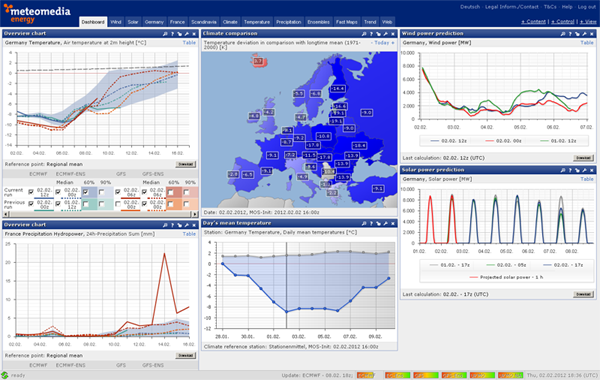
This case clearly shows that AnyChart solution has application in weather forecasting industry and can be succesfully used in other systems.
You can enjoy the full success story here: Meteomedia AG Chooses AnyChart To Visualize Weather Forecasts >>
Or see other AnyChart Customers Success Stories.
January 27th, 2012 by Margaret Skomorokh
Today we start publishing basic tips for choosing between different types of graphs. Visualization can be a very powerful and convincing instrument to present your data – the only thing needed is to use it correctly. One should always clearly understand what exactly he or she wants to show and what is the best way to do it.
There are three main situations when visualizations are made: comparing data, seeing data over time, and breaking data into parts, plus some mixed cases. We will consider them one by one and figure out what type of graphs fits each case. The first post will be about comparing data.
Example 1.
The most common tool for comparing data are bar graphs. For example, here is an AnyChart visualization showing men unemployment rate in the Nordic countries:
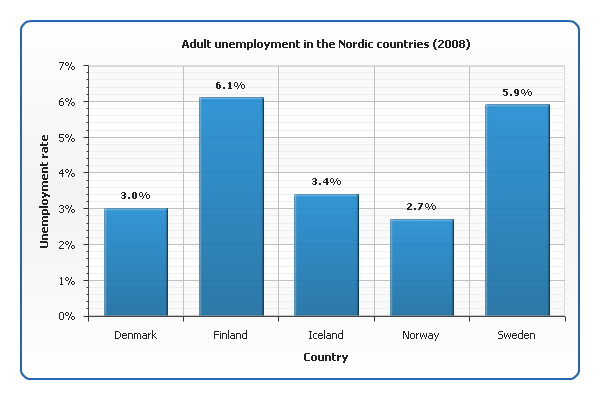 As you can see, the difference in the height of bars represents the difference between values pretty clearly. Note that if you need to put long text labels, it is better to make a horizontal bar graph since the vertical axis gives more space for labeling.
See also our documentation and gallery: Creating Bar/Column Chart with AnyChart, Bar/Column Charts Gallery
Example 2.
What if we want to show not only men but also women unemployment rate? Now we have two sets of data for each country, and to distinguish them, we need to use different colors:
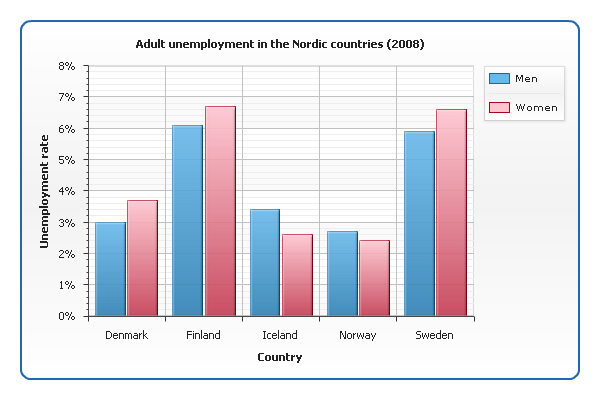 Such graphs are sometimes called double bar graphs. They can also be horizontal.
Example 3.
When one needs to represent the correlation between two related values (which can be viewed as a kind of comparison too), a scatter graph is used. Take a look at a chart showing the correlation between religiosity index and suicide rate in different countries:
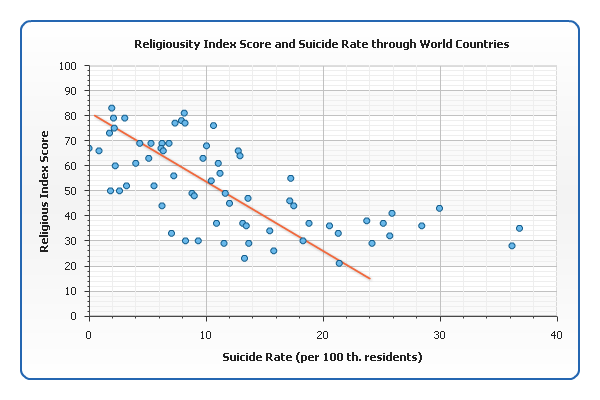 The position of each point on the horizontal and vertical axes is determined by suicide rate and religiosity index correspondingly. Here, like in the previous case, we also have two sets of data for each country, but the countries themselves are no longer at focuse. The things we want to compare are the number of suicides and religiosity index in general.
While bar charts are good for emphasizing the difference between individual entities, scatter graphs are good for generalizing. The information about particular countries is hardly readable from our graph, but it perfectly shows that more religious countries tend to have lower suicide rates: the points group around an imaginary line that falls down from left to right (sometimes called line of best fit, or trend line). It is considered that the closer the points are to this line, the stronger the correlation is.
See also: Creating Scatter Chart with AnyChart, Scatter Charts Gallery
Check the updated article on how to choose chart/graph type for comparing data published within the framework of the new 7-part Choose Chart Type feature on our blog.
December 27th, 2011 by Margaret Skomorokh
Holiday greetings and our best wishes for a happy and prosperous New Year!
During the last year AnyChart has made another big step forward. We have successfully implemented new technologies and improved our products. The family of our customers has grown up, as well as our team (new departments have been opened this year). We are sure that our charts will keep delighting your eye, and that AnyChart is a part of the future of web and charting technologies.
Let the new year be productive and joyful for all of us. And to get into the festive mood, take a look at the picture of a dragon sleigh:

© Vladstudio
December 26th, 2011 by Margaret Skomorokh
Today we have released AnyChart Stock 1.6.0. This version includes the following changes:
New features
- The ability to specify Z-Index for series to define custom display order for regular series and technical indicators series. Read more about this feature at Series common settings: Z-Index.
- The ability to pin a certain value on a value scale to ensure its visibility. For more information, please see: Y-Axes Settings: Pinned Value.
Bug fixes
- Dashed line annotation slow rendering bug has been fixed.
- The fieldType property in the object model is no longer ignored after calling the applySettingsChanges method.
Version history: http://6.anychart.com/products/anystock7/history/
Trial download: https://www.anychart.com/download/
December 12th, 2011 by Margaret Skomorokh
We are proud that our components are succesully used in a wide variety of industries. The success story we are presenting today is about Signatrol Ltd – a company that has been supplying data loggers since 1994. Their products are used in various areas: warehousing, transportation, food preparation, building management, environmental monitoring of offices, schools, museums.
Signatrol created a low cost wireless monitoring solution — spYdaq. It is a system comprising of a number of radio transmitting sensors that measure parameters (temperature, humidity, voltage, etc.) and send them securely by using a license free radio network to a central Basestation. The system has an ability to store information on the dedicated website. And to visualise the data, AnyChart Stock and Financial Charts component was chosen.
The challenge was:
- To make an online visualization of data obtained from a number of different sensors over long periods of time.
- To provide comfortable navigation through complex graphs.
- To integrate graphs into PHP sourced pages, with data obtained from MySQL databases.
AnyStock was used because:
- It allows for visualizing large sets of time-based data by creating fast and easy updatable charts.
- AnyStock supports advanced interactivity and navigation options. Navigation through data is also facilitated by custom text labels and a smart legend.
- Due to simple XML interface, AnyStock is compatible with different kinds of web technologies and database management systems, including PHP and MySQL.
You can enjoy the full success story here:
Other stories can be found here: https://www.anychart.com/company/success_stories.php
November 21st, 2011 by Margaret Skomorokh
We are happy to publish a new success story, this time about AnyChart and Independent Data Services (IDS) – a company from the upstream oil and gas industry.
IDS, founded in 1995, is the world’s largest provider of web-based reporting and analysis services to the upstream oil and gas industry. IDS’ latest release — DataNet2 — makes full use of Web 2.0-compliant technologies and WITSML feeds to capture and deliver data via the web to unlimited users. The DataNet2 suite of products includes VisNet — a back-end query engine which extracts knowledge from every part of the DataNet2 system.
The challenge was:
- To visualize the data returned by VisNet (KPI’s, benchmarks) and create configurable and interactive charts.
- To ensure that all visualizations would be customizable, matching IDS’ high standards.
- To implement a variety of charts.
AnyChart’s charting technology was used to generate visualizations for VisNet because:
- The component allows for the creation of advanced and good-looking animated charts.
- AnyChart is very flexible and provides a lot of features, which made it a good choice for IDS’ project.
- The AnyChart library includes a wide range of charts which is constantly growing. Currently VisNet supports Bar, Column, Pie, Line, and Scatter graphs, but more will be added.
You can enjoy the success story here:
Other stories can be found here: https://www.anychart.com/company/success_stories.php